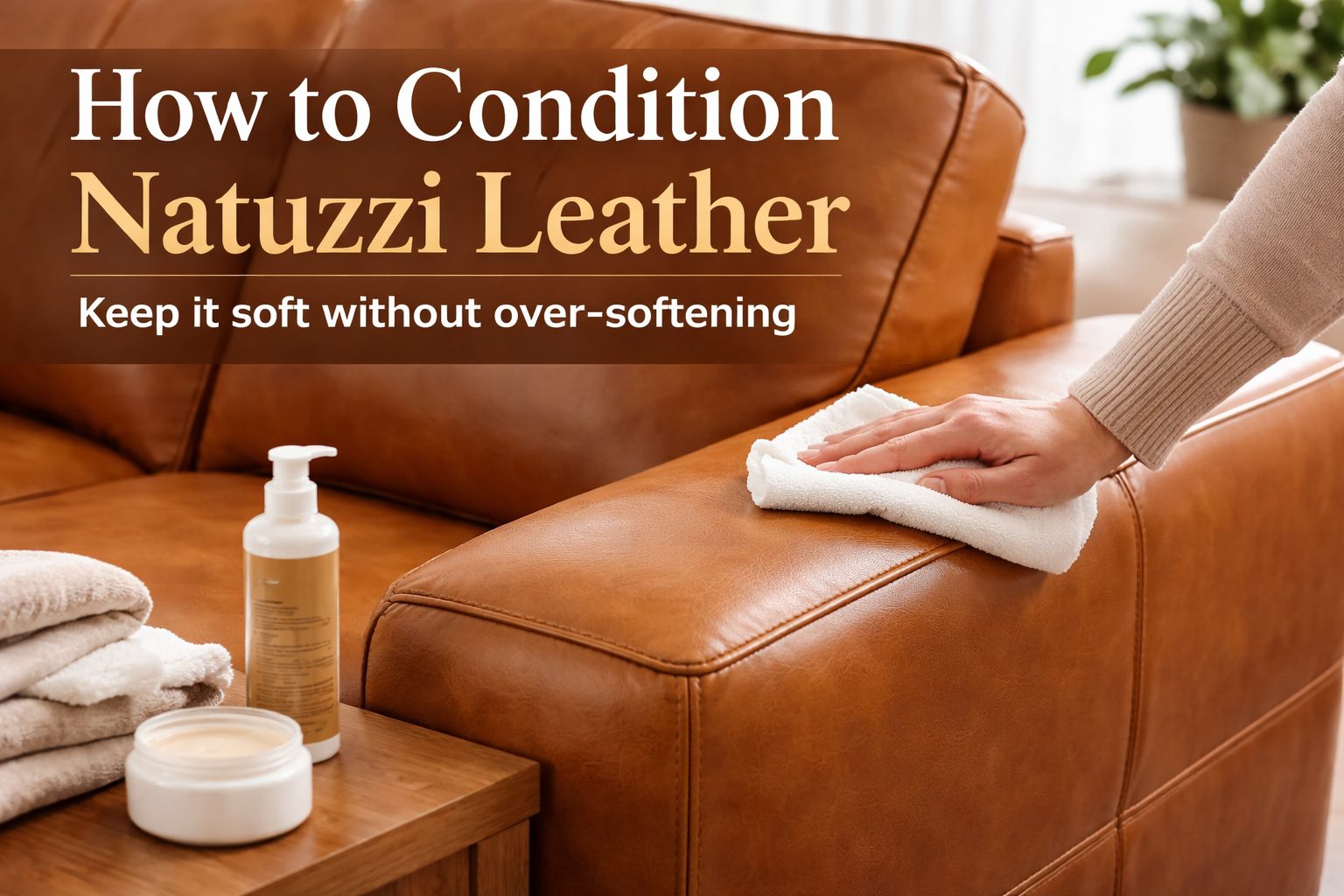
Should you condition Natuzzi leather, when it helps, when it harms, and how to do it without over softening.
If you are searching how to condition Natuzzi leather, you are usually trying to fix one of three things. The sofa feels dry, the leather looks dull, or it has gone the other way and now feels sticky and too soft.
Here is the key point. Not all Natuzzi leathers should be treated the same way. The safest routine depends on the leather finish. For many protected leathers, cleaning and light protection matter more than heavy oil conditioning.
What Natuzzi care guidance is really aiming for
Natuzzi care documents focus on gentle routine maintenance, blotting spills, and avoiding harsh drying. They also describe using the manufacturer cleaner and applying leather protector at intervals, especially on high use seating. That approach is closer to surface protection than feeding the hide with oils.
Because of that, “should I condition it” is not the best question. A better question is, do I need added softness, or do I need a cleaner surface and better resistance to everyday grime.
Step one, identify your Natuzzi leather type
Most everyday living room Natuzzi sofas are a protected, pigmented leather. These are designed to be durable and wipeable. More natural leathers, such as aniline or semi aniline, are more porous and behave differently.
Simple clues for protected leather
Spills sit on the surface briefly, the colour looks more uniform, and the leather feels consistently smooth across panels.
Simple clues for more natural leather
It shows more variation, can darken with moisture, and can absorb body oils more quickly.
If you are unsure, your order paperwork is the most reliable place to check.
Should you condition protected Natuzzi leather
In many UK homes, heavy conditioning is not necessary for protected leather.
Protected leather already has a finish that handles day to day use. When owners over condition it, the most common problems are product build up, a tacky feel, and faster dirt attraction. In high use spots, it can also make the seating feel overly soft compared to the rest of the suite.
When a light protection step can help
After the sofa is properly cleaned, a light protector can help reduce future grime build up, especially on arms, headrests, chaise tops, and the main TV seat.
When conditioning tends to harm
If the leather already feels sticky.
If it looks shiny in patches, which is often residue or abrasion rather than dryness.
If one seat feels much softer than the others, adding more softening product usually makes the contrast worse.
If you are trying to remove natural creases, because conditioning will not remove normal leather creasing.
Should you condition more natural Natuzzi leather
More natural leather can benefit from the correct product used lightly, because it has less surface protection than a fully protected finish. However, it is also easier to mark or darken if you use the wrong cleaner or over apply product.
The goal is controlled replenishment, not soaking. Think thin application, even coverage, and occasional use only when the leather is genuinely dry rather than simply dirty.
How often should you condition Natuzzi leather in the UK
Use the lowest effective frequency and adjust based on use and environment.
Protected leather
Prioritise routine dusting, gentle cleaning as needed, then use a light protector occasionally in high touch zones. Treat twice a year as a sensible benchmark for cleaning and protection in most homes, with extra attention if you have heavy daily use.
More natural leather
Only condition when it shows signs of dryness, and only with a product designed for that finish. Many owners do well with a three to six month check in, but the right answer depends on heating, sunlight, and how much the sofa is used.
A safe routine that avoids over softening
1. Decide what you are solving.
If it feels grimy, clean it. If it feels genuinely dry and tight, then a light conditioning step may help.
2. Dust first.
Use a clean dry soft cloth. This prevents rubbing grit into the surface.
3. Clean before you protect or condition.
Conditioning over dirt locks grime in and can create patchy feel. Use a leather cleaner suitable for your finish and follow the instructions.
4. Patch test.
Test in a hidden area first, especially on more natural leathers.
5. Apply less than you think.
Put product onto the cloth, not directly on the sofa. Work panel by panel.
6. Treat zones, not the whole suite.
Focus on arms, headrests, chaise tops, and the seat front edge. This helps avoid changing the feel of the entire sofa and reduces uneven softening.
7. Let it dry naturally.
Avoid direct heat and strong sunlight while drying.
8. Lightly buff only when fully dry.
Use a clean soft cloth and gentle pressure.
What to avoid if you want to prevent stickiness and over softening
Avoid oil heavy conditioners on protected leather, especially if used frequently.
Avoid silicone shine products that leave residue.
Avoid household cleaners, steam, vinegar mixes, and random wipes not designed for your leather type.
Avoid scrubbing, because real leather finishes can polish and mark.
If your Natuzzi leather feels sticky after conditioning
Sticky usually means residue, either too much product or the wrong product for the finish.
A safer fix
Stop conditioning.
Dry dust first.
Clean gently with a suitable leather cleaner, working evenly by panels.
Let it dry naturally.
Only then consider a light protector, and only if the surface is clean but still picks up grime quickly.
FAQs
Do I need to condition a brand new Natuzzi leather sofa.
Usually not. If anything, a light protector approach in high touch zones makes more sense than heavy conditioning.
Can conditioning remove creases.
No. Creasing is normal on real leather. Conditioning can change feel slightly but will not remove natural creases.
How do I avoid colour change.
Identify the finish, patch test, apply thinly, and avoid over wetting the leather.
Can I use any leather conditioner.
Be careful. Many generic conditioners are not designed for finished furniture leather, and natural leathers need specific products. Matching the product to the finish is the safe approach.
Helpful next reads on SofaMax
How to clean a Natuzzi leather sofa in the UK
https://sofamax.co.uk/how-to-clean-a-natuzzi-leather-sofa-in-the-uk/
Caring for your leather sofa
https://sofamax.co.uk/caring-for-your-leather-sofa/
Natuzzi leather quality explained
https://sofamax.co.uk/natuzzi-leather-quality-explained/
Natuzzi Editions
https://sofamax.co.uk/brand/natuzzi-editions/
Natuzzi Italia
https://sofamax.co.uk/brand/natuzzi-italia/
Sources
https://static.natuzzi.com/production/files/CARE_MAINTENANCE_NATUZZI_EDITIONS.pdf
https://static.natuzzi.com/production/files/Leaflet_CARE_MAINTENANCE_NI_NE_2021.pdf
https://developers.google.com/search/docs/essentials/spam-policies
https://www.bing.com/webmasters/help/webmaster-guidelines-30fba23a