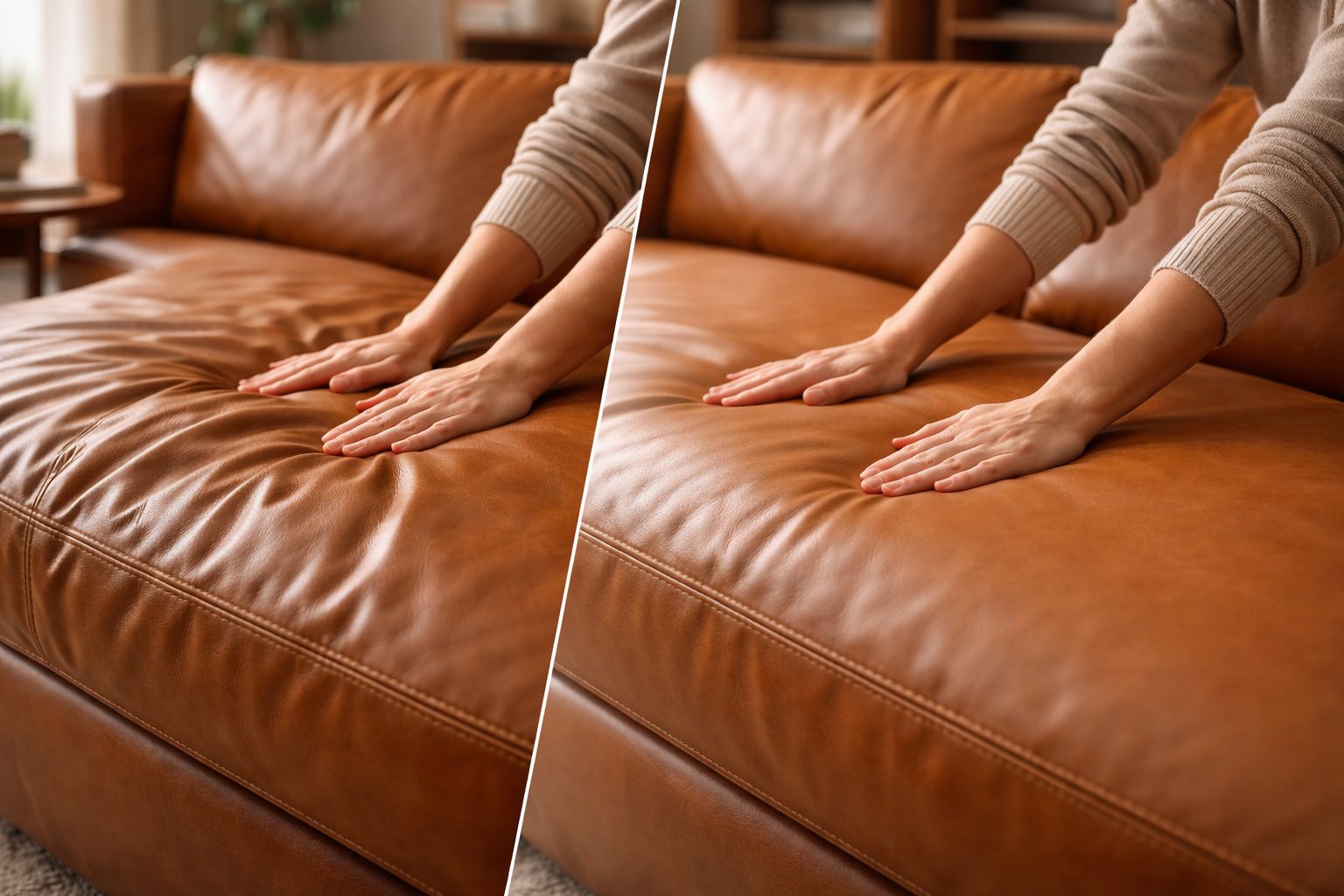
Leather Puddling and Pooling on Sofas, Why It Happens, What’s Normal, How to Keep It Looking Smart
If you have spotted loose looking ripples on your leather seat, you are not imagining it. Leather can relax, crease, and settle into the cushioning, especially in the exact places where you sit most. People call it puddling, pooling, bagginess, or comfort wrinkles. Some even search for leather pudding, meaning the same thing.
Here is the context that matters. Leather is a natural hide. A hide does not behave like a stretched elastic fabric. It flexes, warms, softens, and adapts. Your sofa is also not a rigid bench. It is a comfort system with foam, fibres, webbing, springs, and upholstery layers. When those layers compress and recover, the leather above them moves with the surface. That movement is often normal, and in many designs it is a sign you bought real leather with a soft, comfortable sit.
What “normal” puddling looks like
Normal puddling usually shows as gentle creases on the main seat area, a slightly more relaxed look where you sit every day, and mild rippling on chaises and wide seat spans. It often appears early, then slows down as the cushions settle into their working shape. The sofa still feels supportive, the seams sit straight, and the look is consistent across the seats.
What is more likely to be a problem
There is a difference between surface character and structural loss of support. If the seat suddenly feels like it has collapsed, if one seat is dramatically different from the other with similar use, if seams look pulled or distorted, or if you are seeing excessive loose folds very quickly with light use, it is worth raising it with the retailer. The simplest way to describe it is this. Normal puddling is visual. A fault usually changes how the seat feels and how the upholstery sits around the seams.
Why leather puddles more on some sofas than others
Three factors matter most.
1. Leather type and finish
More natural finishes tend to show character sooner. Softer, more open leathers can look beautifully rich and natural, but they can also show creases more readily. More protected, pigmented, or corrected finishes are generally better at keeping a uniform, tailored look.
2. Cushion build
A plush, sink in seat is achieved with softer foams, fibre wraps, or feather heavy comfort layers. Those layers compress under you, and the leather relaxes with them. A firmer, high resilience foam seat tends to keep a cleaner silhouette because the surface is more stable.
3. Pattern and panel size
Large, uninterrupted seat panels have more visible movement because there is more leather in one continuous span. More tailored upholstery patterns, with thoughtful seams and paneling, can visually control where creases form, so the sofa stays looking sharper for longer.
How to reduce puddling at home without damaging the leather
You cannot turn leather into a perfectly taut drum skin forever, and you should be suspicious of any advice that claims you can. What you can do is reduce how quickly it shows, and keep it looking intentional and well cared for.
1. Spread the load
Stop the sofa being “trained” into one seat. Alternate where you sit, and avoid perching on the very front edge, which creates sharp bends in the same place.
2. Rotate and re seat cushions
If your cushions are reversible, rotate and swap them. In the early weeks, do it more often. After that, monthly is usually enough. If cushions are fixed, lift and gently re seat them so seams sit straight again.
3. Smooth the leather the right way
Use clean, dry hands and smooth from the centre of the seat out towards the edges. Think of it as redistributing the cover tension across the cushion rather than trying to stretch it tighter.
4. Keep it away from heat and harsh light
Drying conditions can make leather less supple over time. Avoid positioning leather directly against radiators, and do not try to flatten creases with direct heat.
5. Condition lightly and correctly
If your manufacturer recommends a conditioner for your finish, use it sparingly and only as often as advised. Always test first in a hidden area. Apply product to a cloth, not straight onto the sofa, then wipe evenly and buff gently. Over conditioning is a real thing and can create its own problems, so less is usually more.
Which sofas to buy if puddling would really annoy you
If you like leather but you want the most tailored look, choose the build that supports that expectation.
1. Choose a more protected leather finish
A protected, pigmented or corrected finish is often the best choice for busy homes and for anyone who wants a cleaner, more uniform appearance.
2. Choose a firmer seat build
High resilience foam and a slightly firmer sit tend to keep shape better. You can still have comfort, but the surface stays more consistent.
3. Choose a more tailored design
Look for designs with more considered paneling and seams on the seat tops, and avoid very large flat leather spans if you want the neatest look long term.
4. Think twice about big, soft chaises
Chaises are brilliant for lounging, but they are also the perfect storm for pooling because of the wide flat surface and the way people sprawl and twist on them. If you want a chaise, pick one with a more structured top panel design and a firmer base feel.
Which sofas to avoid if you want a tight, uniform look
If your personal preference is crisp and tailored, these choices usually bring more visible movement.
1. Very soft, highly natural leathers
They can be stunning, but they tend to show character and creases more readily.
2. Ultra relaxed, sink in seats
Feather heavy or very soft layered seats are made to move with you. The leather will move with them.
3. Minimal seam, wide panel modulars
The fewer visual break points a seat has, the more you will notice any pooling.
A simple line you can use to reassure yourself
A good leather sofa does not stay looking factory flat forever, because it is not meant to. A little movement is the material doing what it does best, adapting to comfort.
If you want to browse leather sofa styles and compare different comfort builds in person, you can start here
Here Is a YouTube video on the subject.
Sources
https://static.natuzzi.com/production/files/Leaflet_CARE_MAINTENANCE_NI_NE_2021.pdf
https://static.natuzzi.com/production/files/CARE_MAINTENANCE_NATUZZI_EDITIONS.pdf
https://www.uniters.com/media/leather/UNITERS%20LEATHER%20CARE%20INSTRUCTIONS.pdf
https://help.sofology.co.uk/hc/en-us/articles/19236961818002-Removing-creases-from-your-leather-sofa
https://www.financial-ombudsman.org.uk/decision/DRN-3606007.pdf