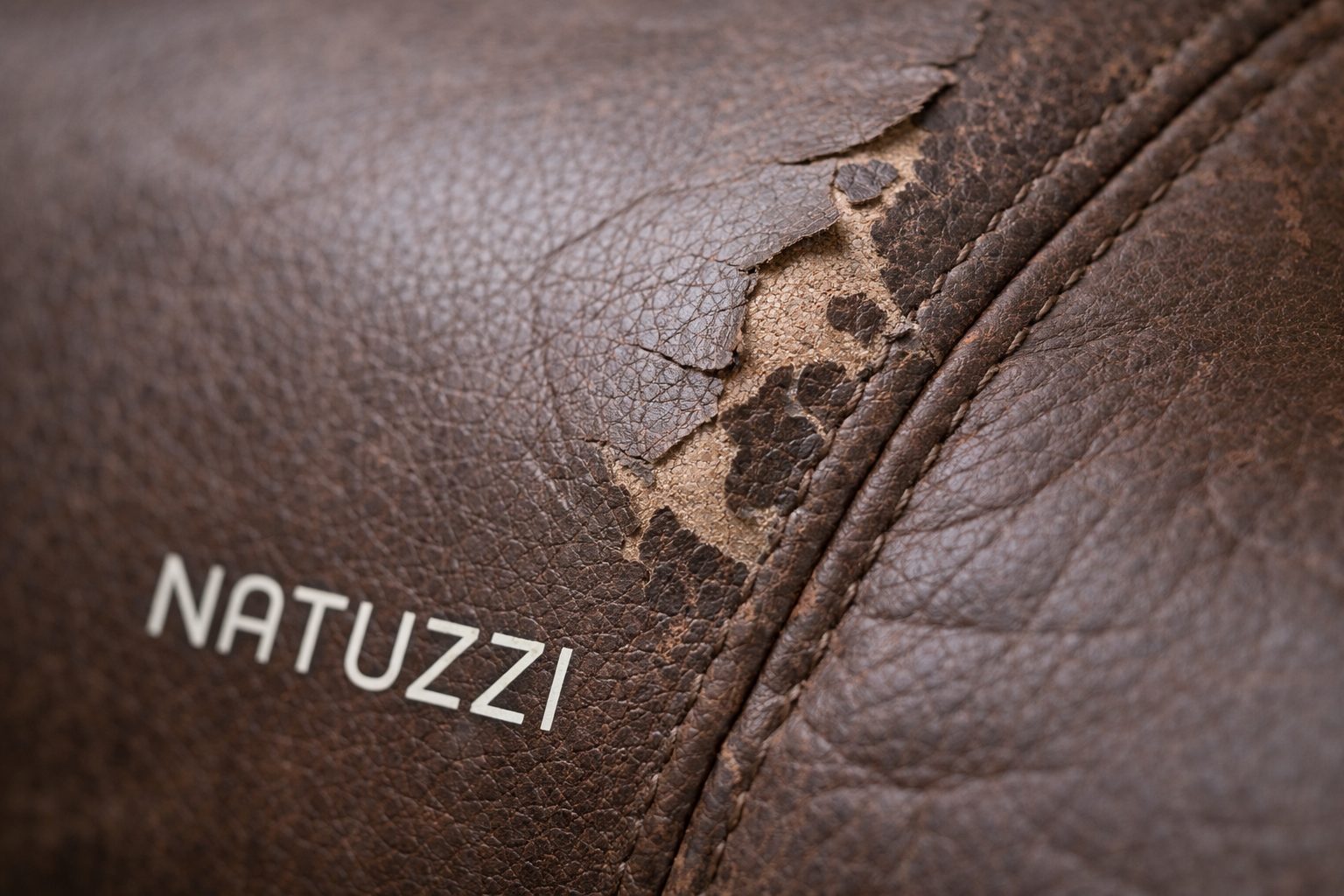
Why Natuzzi leather can peel, how to tell coating wear from damage, what to do now, and how to prevent it in UK homes.
If your Natuzzi leather looks like it is peeling, the most common reality is not that the hide is falling apart. It is usually the surface finish, the thin protective coating and pigment layer, wearing through, lifting, or breaking down in high contact areas. Natuzzi’s current warranty terms explicitly refer to cracking or abrasion of the coating and consequent wear of the surface finish as a normal wear and tear category, not a structural failure.
A quick clarification that matters for diagnosis
In the UK, Natuzzi Editions and Natuzzi Italia ranges are built around genuine leather categories such as Protecta and Natural, plus fabrics. When you see peeling on these ranges, you should treat it as coating wear, contamination damage, or abrasion damage on a finished leather surface, not the classic bonded leather or PVC faux leather delamination story. Protecta leathers, by definition, use a protective layer over genuine leather to improve practicality, so the presence of a finish layer is normal.
What peeling usually is on Natuzzi leather
Most Natuzzi leathers used in everyday homes are finished leathers with a protective surface. That surface can wear, especially where your body and clothing rub most, headrests, arm tops, seat fronts, and the main TV seat. Natuzzi’s care leaflet for Natuzzi Editions specifically tells you to use the specific Natuzzi cleaner and to avoid heat drying, which is consistent with the idea that the surface finish needs gentle handling to stay intact.
Coating wear vs damage, a simple way to tell
Use this quick check, it helps you decide whether you are looking at normal surface wear, or damage that needs a different approach.
- Does it look like a thin film lifting, with leather still underneath
That points to finish wear or finish failure, not the hide tearing. - Is it in one specific high friction spot, especially where a head rubs, an arm rubs, or a seat edge creases
That points to abrasion plus body oils, sweat, hair products, and friction accelerating coating breakdown. - Is the area sticky, shiny, or patchy, as if something has softened the top layer
That often points to unsuitable cleaning products or wipes, or repeated over conditioning with the wrong product type. - Is it directly where sunlight hits every day, or near a radiator
Heat and UV can dry and embrittle finishes over time, which makes cracking and flaking more likely. Natuzzi’s care guidance repeatedly warns against drying leather in direct sunlight or using heat like a hair dryer.
Why Natuzzi leather can peel, the most common causes in UK homes
Friction and abrasion
Jeans seams, belt studs, zips, and repeated sliding in and out of the same seat can gradually abrade the surface finish. Once the finish is thin, it can start to lift at edges and creases.
Body oils, hair products, and skincare
Headrests and arm tops are the classic zones. Oils and waxes can slowly weaken a finish layer, especially when combined with warmth and friction.
Heat and sunlight
Direct sun on a headrest or arm can speed up drying. Heat sources can also dry the finish and make it brittle. Natuzzi’s own care leaflets emphasise avoiding heat drying and direct sunlight drying.
The wrong cleaning routine
Baby wipes, antibac sprays, solvents, degreasers, and harsh multi surface cleaners can strip or soften a finish. Even some generic “leather conditioners” can leave residue that attracts dirt, increases friction, and accelerates wear on finished leathers.
Infrequent cleaning on high use seats
If dirt and oils build up, they act like abrasive paste. A gentle routine clean matters more than heavy occasional treatments. Natuzzi’s guidance supports regular dusting and prompt gentle action on spills, then the specific Natuzzi cleaner when needed.
Prevention, what to do from today
- Move the sofa away from direct heat and strong sun where possible, or use blinds in peak hours.
- Stop using wipes and unknown sprays, and do not apply oils or heavy conditioners unless you know the leather type and the product is designed for finished upholstery leather.
- Clean lightly but regularly, dust weekly with a clean, dry cloth, then use the specific cleaner when needed, following Natuzzi guidance.
- Rotate seating if you can, the main seat wears first.
- Treat high contact zones as maintenance zones, headrests and arm tops need the gentlest routine because they get the most oils and friction.
Realistic fixes, what works and what does not
If the coating is only lightly worn or slightly flaking
A thorough, gentle clean to remove oils and residue can stabilise the surface. Then a compatible protector can help reduce future staining and reduce how quickly grime binds. Do not expect this to rebuild missing colour or reattach a lifting finish permanently.
If colour is coming off and you can see a lighter base
You are usually in recolour and refinish territory. That is typically a dye or pigment system plus a new topcoat. A professional repairer can often make it look dramatically better, especially on small areas like an arm top, but it is still a repair, not a factory new finish.
If the finish is actively lifting in sheets
Cleaning alone will not re bond a failing topcoat. You are looking at a refurbishment process that removes unstable finish, recolours, then reseals. At this point, DIY can go wrong quickly, patchiness, hard edges, and mismatched sheen are common. A professional is usually the best value.
If the leather is cracked through, or the surface is physically torn
No consumer kit fixes structural damage. You are in panel replacement or specialist restoration territory.
Warranty reality, and what to do if your sofa is not old
Natuzzi’s published warranty terms explicitly treat cracking or abrasion of the coating caused by normal use, and consequent wear of the surface finish, as wear and tear rather than a defect.
That does not remove your UK statutory rights. Under the Consumer Rights Act 2015, goods must be of satisfactory quality and durable, and there are specific remedies depending on timing and evidence. If a fault appears within the first six months, it is generally presumed to have been there at delivery unless the retailer can show otherwise. After six months, the burden of proof typically shifts and you may need evidence such as an expert report.
If you think your peeling is abnormal for the age and use
- Photograph the issue in good light, include wide shots and close ups.
- Write down the timeline, when you first noticed it, what products have been used, whether it is in sunlight or near heat.
- Contact the retailer first, not the courier or manufacturer, and ask for an inspection process.
- Be clear about the outcome you want, repair, recolour, replacement parts, or a contribution.
Frequently asked questions
Is Natuzzi leather peeling the same as bonded leather peeling
No. With Natuzzi Editions and Natuzzi Italia, peeling is usually surface finish wear or damage on finished genuine leather, not a bonded leather or PVC faux leather delamination scenario. Protecta leathers, in particular, use a protective layer by design, which can wear in high contact zones over time.
Why is it only peeling on one seat
The main seat gets more friction, more body oils, more heat, and more repeated compression. That accelerates finish wear.
Can I fix it with a conditioner
Conditioner is not a cure for finish peeling. On finished leathers, heavy conditioners can make things worse by leaving residue that attracts dirt and increases abrasion. Focus on gentle cleaning and correct protection, then consider professional refinishing if colour is already lost.
Should I use the Natuzzi cleaner
Natuzzi’s own care leaflet advises using the specific Natuzzi cleaner for stains, and emphasises gentle methods and avoiding heat drying. That is a safe baseline.
When should I call a professional
If the peeling is spreading, if colour is lifting in patches, or if the finish is lifting at edges. A professional can usually blend colour and reseal more evenly than a DIY patch.
Internal links and sources
Internal links
https://sofamax.co.uk/brand/natuzzi-editions/
https://sofamax.co.uk/brand/natuzzi-italia/
Sources
https://documents.natuzzi.com/doc/id/warranty_and_instructions/Warranty_ww_2025.pdf
https://static.natuzzi.com/production/files/CARE_MAINTENANCE_NATUZZI_EDITIONS.pdf
https://www.natuzzi.com/al/en/materials
https://www.checkatrade.com/blog/expert-advice/peeling-leather-sofa/
https://theleatherexpert.co.uk/how-to-diagnose-leather-sofa-problems/
https://www.finlinefurniture.ie/why-is-my-leather-sofa-peeling/
https://www.furnitureclinic.co.uk/problem-solver
https://developers.google.com/search/docs/essentials
https://developers.google.com/search/docs/essentials/spam-policies
https://www.which.co.uk/consumer-rights/regulation/consumer-rights-act-aKJYx8n5KiSl
https://www.legislation.gov.uk/ukpga/2015/15/pdfs/ukpga_20150015_en.pdf